


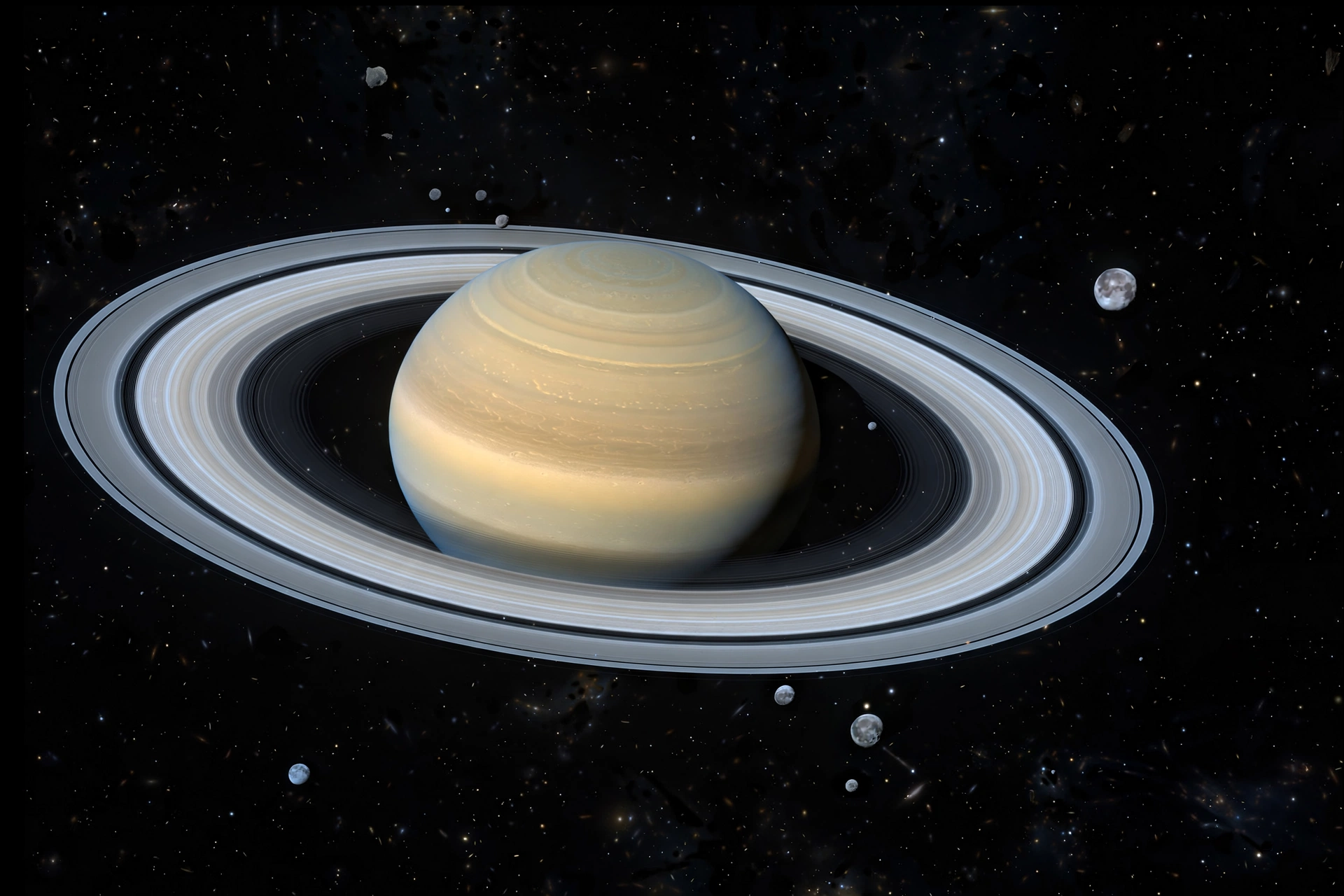
The headline: Saturn now has 274 confirmed moons. Astronomers have recognised 128 additional moons around the planet, up from the previous total of 146, giving Saturn more moons than all the other planets combined. The short version: the new moons are tiny, distant fragments found by a patient telescope survey, and their strange orbits tell a story of capture and collision in the early solar system.
The bulletin facts
The survey used the Canada-France-Hawaii Telescope on Mauna Kea in Hawaii, gathering deep images over several years. The team included researchers from the University of British Columbia, including Dr Edward Ashton, a specialist in the faint outer reaches of the giant planets. After candidates were tracked long enough for reliable orbits to be calculated, the moons were recognised by the International Astronomical Union. The observatory’s own site, the Canada-France-Hawaii Telescope, explains the facility behind the observations.
Detection relied on a method called shift and stack. Images were shifted to match Saturn’s movement and combined, so a moon too faint to notice in one frame could build into a clear signal across many. It is painstaking work, closer to auditing an enormous archive than to glancing through an eyepiece, and it explains why confirmations arrived in a batch rather than one at a time.
What kind of moons are these?
Small ones. Most measure only a few kilometres across and would be better described as irregular chunks than as miniature worlds. They orbit far from Saturn on tilted paths, and many travel retrograde, opposite to the planet’s rotation. Astronomers believe the pattern points to an origin outside Saturn’s original moon system: larger bodies were captured by gravity, then shattered by collisions, leaving families of fragments on related orbits.
That makes each addition useful. A fragment family is evidence of an impact and a rough guide to when it happened. Together, the 128 confirmations fill in parts of Saturn’s history that its bright rings and large, familiar moons cannot tell on their own.
In context for today’s readers
Regular readers may remember our coverage of a SpaceX launch that left a jellyfish-shaped cloud over the East Coast, a space event anyone could step outside and see. Today’s bulletin is the other end of astronomy: objects nobody can see unaided, identified because researchers kept returning to the data until uncertainty gave way to an orbit and a name in the catalogue.
The takeaway
Saturn’s lead in the moon count is now so large that it is unlikely to be a temporary headline. More faint candidates probably remain in survey data, so 274 may rise again. But even if it never changed, the result would stand as a reminder that familiar planets still hold uncounted companions, and that careful, repeated observation can revise a fact as basic as how many moons the most recognisable planet in the sky actually has. That is the bulletin: a bigger Saturn system, a clearer picture of its violent past, and a survey method likely to keep producing discoveries.
More detail behind the numbers
It helps to separate the three numbers in this story. The first is 146, the total Saturn carried into this announcement after earlier surveys had already pushed it past Jupiter. The second is 128, the size of the newly confirmed group, which is unusually large for a single recognition because the underlying observations and orbit calculations were completed as a connected body of work. The third is 274, the new total, and the one that will appear in reference tables from now on.
It also helps to understand what confirmation protects against. The sky around Saturn is crowded with background stars, distant asteroids and image artefacts that can imitate a moon in a small set of frames. Requiring a candidate to follow a calculated orbit over a long baseline removes most of those impostors. What survives that filter is a conservative list. Astronomers are therefore comfortable saying at least 274, while expecting that improved processing of the same survey fields, and new observations with future instruments, will eventually add smaller and fainter members that current data cannot yet certify.
