


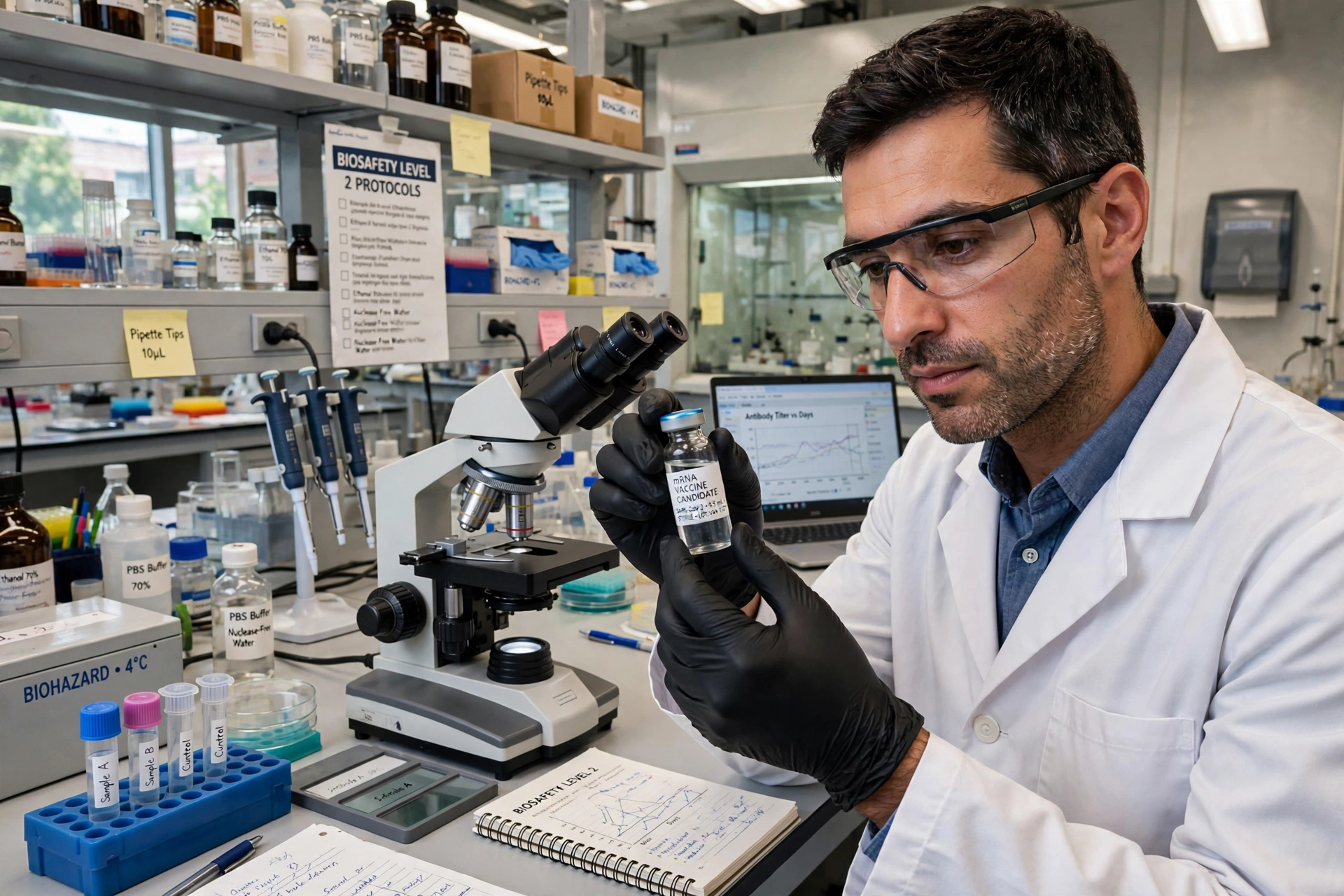
The headline: a personalised cancer vaccine called NeoVax could be manufactured for individual patients and administered with nivolumab in a phase 1 trial in platinum-sensitive recurrent ovarian cancer. The caution: this was a small early study, published in Nature Medicine, designed mainly to test feasibility and safety. It reported acceptable safety and immune responses. It did not establish that the vaccine treats cancer effectively, and today’s bulletin will not claim otherwise.
What NeoVax is
NeoVax is created from the mutations found in a patient’s own tumour. Those mutations can generate neoantigens, abnormal fragments that may alert the immune system because they differ from healthy tissue. A vaccine is then produced around selected targets for that one person. Nivolumab, the companion drug, is a PD-1 immune checkpoint inhibitor intended to reduce a restraint on T cells. One component aims to teach recognition; the other aims to loosen a brake.
Readers who want reference material can consult the National Cancer Institute for ovarian cancer information and Nature Medicine for the journal in which the study was published. The distinction between these sources and social media summaries matters, because early trial language is precise for a reason.
What the trial actually found
First, feasibility. Building a different vaccine for each participant is a demanding process involving tumour analysis, target selection, production and scheduling. The investigators reported that it could be done and that patients received their vaccines in combination with nivolumab. Second, safety was judged acceptable at this early stage, the standard phase 1 question. Third, researchers observed T-cell responses, evidence that the immune system reacted to the vaccination approach in measurable ways.
Each finding is worthwhile and each has a limit. A process that works in a specialist trial may still be too slow or costly at scale. Safety in a small, selected group cannot cover every future patient. And immune responses, while necessary for the idea to make sense, are not proof that tumours were controlled or lives extended. The study population also matters: recurrent disease that remained platinum-sensitive is a narrower group than everyone living with ovarian cancer.
From our health desk
This bulletin follows our recent reporting on measles cases surging in the United States, where established prevention is being undermined by falling uptake. The contrast is instructive. Measles vaccination is proven and routine; NeoVax is experimental and bespoke. Good health reporting keeps those categories separate even when both stories use the word vaccine, because readers deserve to know how much evidence stands behind what they are reading.
The bottom line for today
NeoVax plus nivolumab has passed an early practical examination: personalised vaccines were made and delivered, safety was acceptable in the trial context, and immune responses appeared. The unanswered questions are the big ones, including clinical benefit, durability, cost and which patients might be helped. Larger trials are needed before any stronger conclusion can be drawn. Until then, file this under genuine scientific progress, carefully stated, rather than a breakthrough treatment available today.
Questions and answers for readers
Is NeoVax available now? No. It was studied in a clinical trial, and personalised vaccines of this kind are not a routine offering for ovarian cancer patients. Did the trial show it works? It showed the approach was feasible, safety was acceptable and immune responses occurred. Showing that it works, in the sense of improving outcomes, is a job for larger trials. Why combine it with nivolumab? Because the vaccine is meant to teach T cells what to recognise, while the checkpoint inhibitor reduces a signal that can restrain those cells.
Who was in the study? People whose ovarian cancer had returned and whose disease was described as platinum-sensitive, a narrower group than all ovarian cancer patients. What happens next? Researchers need bigger studies, longer follow-up and a clearer picture of manufacturing cost and timing. Readers who see stronger claims elsewhere should check them against those five answers. They capture both the real progress in this bulletin and the evidence that is still missing before NeoVax can be described as a treatment rather than an investigation.
