


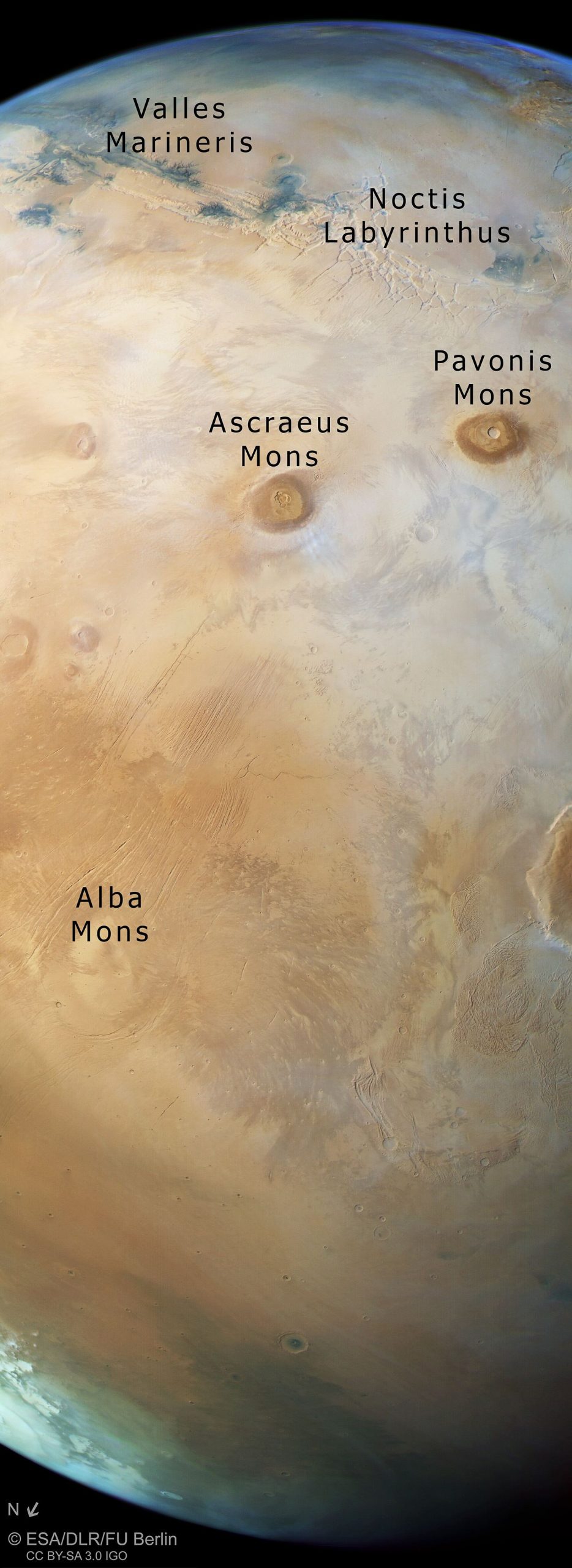
Gas seeping from cracks on Mars suggests the planet is not geologically dead deep inside, but merely sleeping, with magma possibly still moving beneath the surface. The evidence was published in Science Advances on 4 November 2026 by an international team led by Alexander Trokhimovskiy of the Space Research Institute at the Russian Academy of Sciences. The ExoMars Trace Gas Orbiter, a joint mission of the European Space Agency and Roscosmos, recorded unexpected spikes of hydrogen chloride above the northern hemisphere in early summer. The spikes repeated across multiple Mars years, each nearly two Earth years long, and always appeared above fresh fissures on the flanks of Alba Mons, a giant shield volcano spanning roughly the area of the contiguous United States. Hydrogen chloride is a gas that hot magma produces on Earth.
What the Evidence Shows
The pattern is what makes the finding convincing. The gas appeared just after the frosts of winter sublimated, as if ice sealing the fissures had melted and let the trapped gas escape, and the ground around the cracks shows discolouration like the deposits left around volcanic gas vents on Earth. The team’s cameras found young, narrow fissures spanning tens to hundreds of metres, and the gas was detected at parts-per-billion levels, a handful of molecules spotted by an orbiter moving continuously around the planet. The researchers suggest a dormant magma chamber hides below Alba Mons, a kind of volcanic plumbing system under the surface. If Mars still holds enough internal heat for magma, the warm fissures could host environments like Earth’s hydrothermal vents, where life on our planet may have emerged, and they become places to search for life on Mars. Reporting and analysis from sources such as NASA track the same developments, and specialists following volcanic gas on Mars say the direction is now consistent across independent lines of evidence.
The Wider Context
Funding bodies are watching volcanic gas on Mars closely because the work sits at the junction of basic curiosity and practical return. Grant panels increasingly ask for a path from discovery to application, while researchers push back that the most valuable uses of fundamental science are rarely the ones written into the original proposal. The tension is productive when both sides stay honest about timescales.
What Happens Next
The long view on volcanic gas on Mars is that fields advance by accumulation rather than by single announcements. This result adds a solid, checkable piece to a structure many teams are building, and its authors have shared their data so the piece can be tested from every side. That is how the picture eventually becomes reliable enough to act on. You can follow related developments in our coverage of science.
It is also worth remembering how quickly the picture in this area has changed before. Positions that looked settled a few years ago have been revised as new data arrived, and the same humility is appropriate now. The strongest coverage of this subject, and the most useful advice, tends to come from sources that update their views openly when the facts move, rather than defending an earlier position long after it has stopped fitting the evidence available.
